



The numbers tell a familiar story. The vast majority of organizations believe AI will deliver competitive advantage. Yet research consistently shows that most machine learning projects never make it to production.
That gap between belief and execution is your career opportunity.
Across supply chain organizations right now, planners are quietly using ChatGPT to draft supplier emails. Analysts paste demand data into AI tools without guidance. Procurement specialists experiment with contract analysis on personal accounts. Leadership has no visibility into any of it.
The result: fragmented experimentation, potential data exposure, and an illusion of productivity where faster output masks hidden rework and compliance risks.
Someone needs to bring order to this chaos. That person builds credibility, visibility, and career leverage. The role doesn’t require a VP title or a computer science degree. It requires curiosity and initiative.
Which raises the question: what does it take to become that person in supply chain?
The supply chain AI champion profile
The AI champion role isn’t reserved for senior leadership or data scientists. Many successful champions are mid-level professionals: demand planning managers, logistics coordinators, procurement leads, S&OP analysts. What defines them is a specific combination of mindset and action.
Intellectual curiosity over credentials
Champions commit to learning the material themselves. One effective approach: use AI tools to accelerate your own AI education. ChatGPT can summarize dense industry reports from McKinsey or Gartner on supply chain transformation, letting you ask clarifying questions and internalize concepts faster than traditional reading allows.
You don’t need to understand neural networks. You need to understand what AI can do for inventory optimization, demand sensing, and supplier risk management.
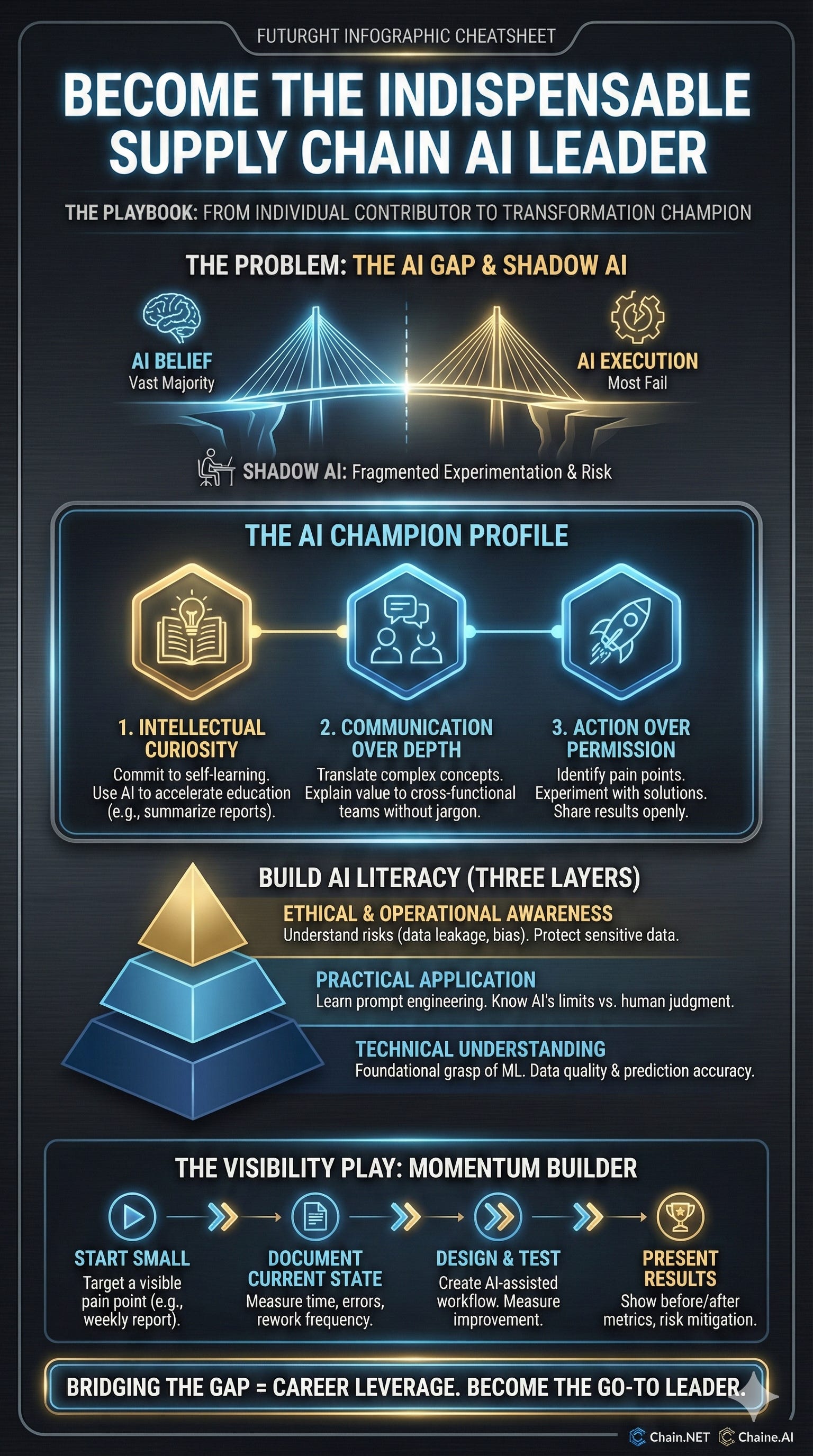
Communication over technical depth
Strong champions translate complex concepts into clear, operational terms. Your value isn’t in understanding transformer architecture. It’s in helping a warehouse manager see how AI-powered demand forecasting affects their labor planning, without jargon or hype.
Supply chain runs on cross-functional collaboration. The champion who can explain AI value to finance, operations, and IT simultaneously becomes indispensable.
Action over permission
Champions don’t wait for a digital transformation mandate from the C-suite. They identify their team’s pain points, experiment with solutions, and share results openly. This proactive stance separates people who talk about AI from leaders who demonstrate its value.
The demand planner who builds a proof-of-concept for exception reporting gets noticed. The one who waits for IT to propose something gets left behind.
Build supply chain AI literacy in three layers
AI literacy is the baseline capability for using AI effectively, ethically, and safely. For supply chain professionals, it breaks into three components.
Technical understanding
You don’t need to code. You need a foundational grasp of how AI systems work: what machine learning means for demand forecasting, why data quality determines prediction accuracy, why AI produces confident-sounding errors that could wreck your inventory planning.
This understanding helps you explain to colleagues why an AI-generated demand forecast still needs human validation before driving a $2 million purchasing decision.
Practical application
Learn prompt engineering, the skill of formulating requests that get useful results. Understand what AI can and cannot do within supply chain operations. Know when human judgment is non-negotiable.
AI can summarize a 50-page supplier audit report in seconds. It cannot decide whether to terminate a strategic partnership based on that summary. Knowing the boundary is what separates smart AI users from dangerous ones.
Ethical and operational awareness
Supply chain data is sensitive. Supplier pricing, customer demand patterns, logistics costs, contract terms. Feeding this information into public AI tools creates exposure your legal and procurement teams would never approve.
AI champions know the risks: data leakage, algorithmic bias in supplier selection, the danger of automating decisions that require human accountability. This awareness protects both your career and your organization.
The visibility play that builds momentum
With literacy established, the next question becomes: how do you prove value in a way that creates career leverage?
Start with a single, visible pain point. Not the most complex problem in your supply chain. The most annoying one. The weekly report everyone dreads. The exception handling process that eats three hours every Monday. The supplier communication backlog that never gets cleared.
Document the current state. Time spent, error rates, rework frequency. Then design an AI-assisted workflow using the trigger-input-output framework. Test it yourself. Measure the improvement.
Now you have something concrete to present: before and after metrics, risk mitigation approach, and a specification IT can actually evaluate.
This is how champions build credibility. Not by proposing grand transformation initiatives. By solving real problems and showing receipts.
From individual contributor to transformation leader
The supply chain professionals getting promoted right now share a common trait. They saw the AI adoption gap before leadership did. They built literacy while others waited for training programs. They demonstrated value while others debated risks.
Every organization needs someone who can bridge the gap between AI potential and operational reality. Someone who speaks both the language of supply chain and the language of intelligent systems.
That person becomes the natural choice when leadership needs an AI initiative led. When governance committees need supply chain representation. When the board asks who understands this technology well enough to guide investment decisions.
You don’t need permission to become that person. You need curiosity, initiative, and a willingness to learn in public.
The gap between AI belief and AI execution is your opening. The question is whether you’ll step into it.
Ready to accelerate your AI leadership journey? Join our community at Chain.NET to connect with supply chain professionals who are navigating this transformation together. Explore the latest AI-powered supply chain solutions at Chaine.AI to see what’s possible when you move from experimentation to implementation.
Now I want to hear from you. Are you seeing shadow AI usage in your supply chain organization? Have you started positioning yourself as the go-to AI resource for your team? What’s the biggest barrier stopping you from stepping into this role? Share your thoughts and experiences in the comments. The best insights come from practitioners who are living this transition every day.